Introduction
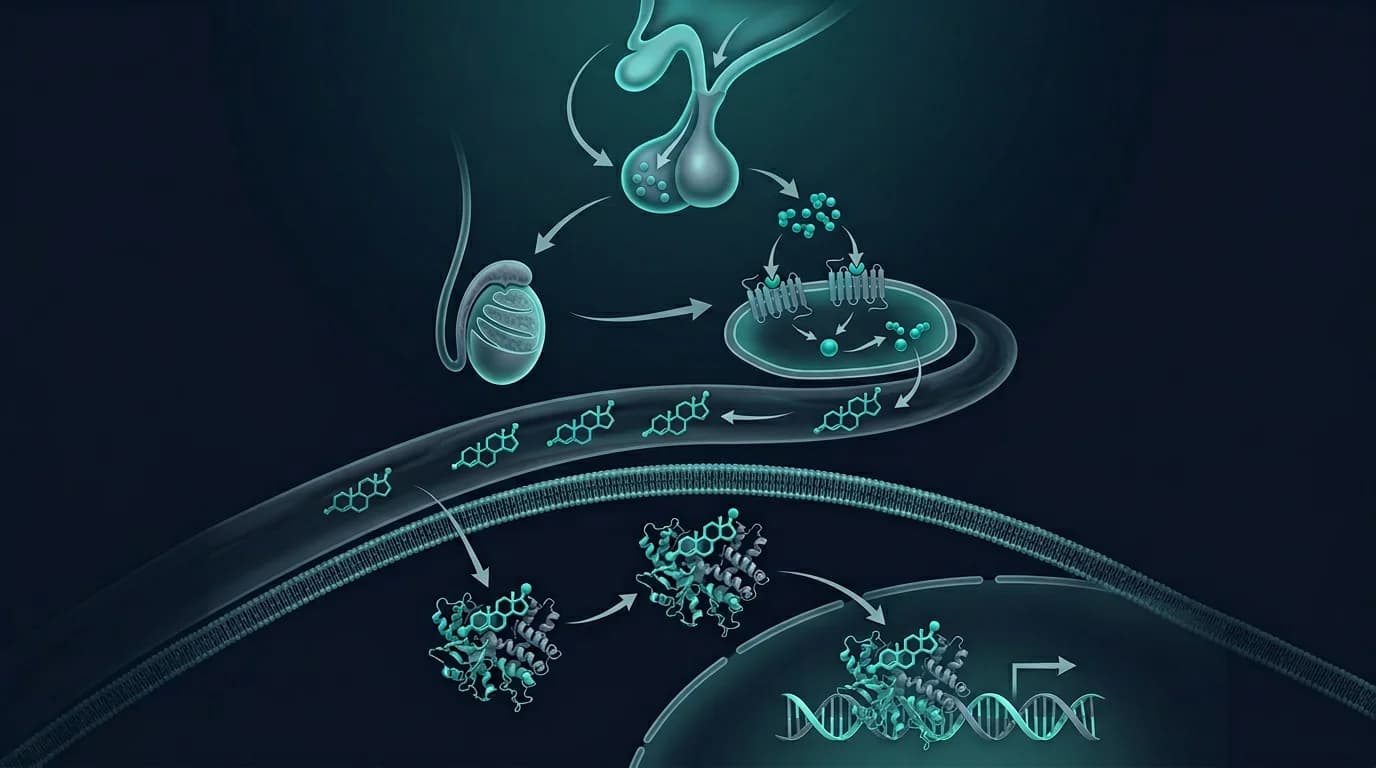
The hypothalamus does not shout continuously -- it whispers in pulses. Every 60-120 minutes, a burst of GnRH travels from the hypothalamus to the pituitary, triggering a corresponding pulse of LH. This pulsatility is not just a feature of the system; it is essential for optimal function. Continuous GnRH signaling actually suppresses testosterone production.
Gonadorelin is synthetic GnRH, identical to the hormone your hypothalamus naturally produces. When administered in a pulsatile pattern, it mimics natural signaling and supports the entire downstream cascade: LH release, Leydig cell stimulation, and testosterone production through physiological mechanisms.
For those seeking to support testosterone production while maintaining natural axis function, gonadorelin offers an interesting approach. In this article, you will learn how pulsatile GnRH signaling controls testosterone, why this matters for metabolic health, and how FixMyT helps you understand your hormonal architecture.
Understanding Testosterone: The Expression of Your Metabolism
Testosterone represents the final output of the FixMyT metabolic tree at Level 4: Androgen Expression. Its subtitle "Expression" reflects the reality that testosterone is not an isolated hormone but the culmination of everything working properly upstream.
The FixMyT framework shows testosterone depending on:
- Nutrition and Mitochondria (Level 1): Energy and raw materials
- Gut, Liver, Thyroid (Level 2): Hormone processing and activation
- Low Cortisol/Estrogen/Prolactin/Serotonin (Level 3): Minimal interference
- Progesterone and DHT (Level 4): Supportive hormonal environment
When testosterone is low, the root cause could be anywhere in this tree. Low testosterone symptoms -- fatigue, low libido, muscle loss, brain fog, depression -- cascade through every aspect of life.
Gonadorelin addresses the signaling component: ensuring the brain's message to produce testosterone is being properly transmitted to the pituitary and testes.
What Is Gonadorelin?
Gonadorelin is synthetic GnRH (Gonadotropin-Releasing Hormone), a decapeptide identical to the natural hormone produced by the hypothalamus.
Key characteristics of Gonadorelin:
- Sequence: pGlu-His-Trp-Ser-Tyr-Gly-Leu-Arg-Pro-Gly-NH2 (10 amino acids)
- FDA status: Approved for diagnostic and therapeutic use
- Mechanism: GnRH receptor agonist on pituitary gonadotrophs
- Administration: Subcutaneous (50-200 mcg, 2-3x daily)
- Half-life: 2-4 minutes (very short)
- Unique feature: Identical to natural GnRH; maintains pulsatility
The extremely short half-life is actually essential to its mechanism. Each dose creates a discrete pulse rather than continuous stimulation. This pulsatile pattern is what stimulates the axis -- continuous GnRH paradoxically suppresses it.
For the complete technical profile, see the full Gonadorelin profile on PepGuide.
How Gonadorelin Supports Testosterone Function
Gonadorelin supports testosterone through natural signaling pathways, maintaining physiological patterns:
1. Pituitary Stimulation
When administered as pulses, gonadorelin:
- Binds to GnRH receptors on pituitary gonadotrophs
- Activates intracellular signaling cascades
- Triggers release of LH and FSH
- Maintains the pulsatile pattern essential for optimal function
2. LH-Driven Testosterone Production
The LH released stimulates the testes:
- Travels to Leydig cells
- Activates testosterone synthesis
- Creates endogenous testosterone production
- Maintains intratesticular testosterone levels
3. Preserved Feedback Mechanisms
Unlike exogenous testosterone, gonadorelin works through natural pathways:
- Feedback from testosterone remains functional
- The system self-regulates to some degree
- Less likely to create supraphysiological levels
- More closely mimics healthy natural function
4. FSH and Testicular Health
Gonadorelin stimulates both LH and FSH:
- FSH supports Sertoli cells and spermatogenesis
- Maintains broader testicular function
- Supports fertility alongside testosterone
- Creates comprehensive testicular stimulation
5. Why Pulsatility Matters
The distinction between pulsatile and continuous is critical:
| Pulsatile GnRH | Continuous GnRH |
|---|---|
| Stimulates LH/FSH | Suppresses LH/FSH |
| Supports testosterone | Lowers testosterone |
| Maintains fertility | Suppresses fertility |
| Natural pattern | Pharmaceutical suppression |
This is why GnRH agonist drugs (continuous) are used for prostate cancer suppression, while pulsatile gonadorelin stimulates testosterone production.
What Real People Are Saying
Gonadorelin is used in various clinical contexts, and experiences have been shared:
"Using gonadorelin 100mcg twice daily as part of a monotherapy trial for mild hypogonadism. My testosterone went from 350 to about 550 over 8 weeks, which is significant for a natural approach. LH and FSH both came up appropriately, suggesting the axis is responding to the stimulation." -- u/natural_axis_approach on r/Testosterone
"Added gonadorelin to my PCT protocol after a cycle. The axis restart was faster and felt more complete than with just HCG/SERM. My natural testosterone production returned to baseline more quickly, and I retained more of my gains. The pulsatile approach seems to wake up the system better." -- u/pct_evolution on r/steroids
"Gonadorelin has been an interesting alternative to HCG for testicular support on low-dose TRT. Instead of bypassing the pituitary entirely, I'm stimulating it. My testosterone stays stable, testes remain normal size, and I feel like the system is more 'online' than with TRT alone." -- u/physiologic_support on r/Peptides
These experiences reflect various applications of gonadorelin for testosterone support.
Monitoring Your Testosterone Health with FixMyT
Understanding where your testosterone optimization opportunity lies requires mapping the full picture. FixMyT provides this comprehensive assessment.
The FixMyT symptoms quiz evaluates:
- Testosterone symptoms (energy, libido, muscle, mood)
- Signaling function (LH, FSH responses)
- Upstream factors (thyroid, cortisol, nutrition)
- Interference patterns (estrogen, prolactin)
The visual metabolic tree shows how testosterone depends on everything upstream. If your primary issue is signaling (the brain's message not reaching the testes effectively), gonadorelin may be highly relevant. If the issue is interference (high cortisol, high estrogen), addressing those may be the priority.
For those researching gonadorelin, FixMyT helps identify whether axis stimulation is the right approach.
Research and Considerations
Gonadorelin has FDA approval and decades of clinical use, primarily for fertility and diagnostics.
What the evidence supports:
- Pulsatile gonadorelin stimulates LH/FSH release (well-established)
- Restores testosterone in hypogonadotropic hypogonadism
- Maintains testicular function and fertility
- More physiological than direct hormone replacement
- Good tolerability with established safety profile
What needs more research:
- Optimal protocols for testosterone optimization in aging men
- Comparison with other approaches (hCG, kisspeptin)
- Long-term outcomes in wellness optimization contexts
- Individual variation in response
The evidence supports gonadorelin for axis stimulation; optimization protocols continue to evolve.
Disclaimer
This article is for educational and research purposes only. Gonadorelin is an FDA-approved prescription medication. Nothing in this article constitutes medical advice or a recommendation to use any substance.
Gonadorelin administration requires proper protocol design. The difference between pulsatile (stimulating) and continuous (suppressing) is critical and requires medical guidance.
Any decisions about health interventions remain your responsibility in consultation with appropriate medical professionals.
Learn More
- Full Gonadorelin Profile on PepGuide - Complete technical details
- HCG for Direct Testicular Stimulation - Alternative approach
- FixMyT Metabolic Assessment - Understand your HPG axis function
- Kisspeptin for Upstream Signaling - More upstream approach
References
-
Conn PM, Crowley WF Jr. "Gonadotropin-releasing hormone and its analogs." Annual Review of Medicine. 1994;45:391-405.
-
Schally AV. "LH-RH analogues: I. Their impact on reproductive medicine." Gynecological Endocrinology. 1999;13(6):401-409.
-
Santen RJ, Bardin CW. "Episodic luteinizing hormone secretion in man." Journal of Clinical Investigation. 1973;52(10):2617-2628.
-
Crowley WF Jr, et al. "Therapeutic use of pituitary desensitization with a long-acting GnRH agonist: a potential new treatment for idiopathic precocious puberty." Journal of Clinical Endocrinology & Metabolism. 1981;52(2):370-372.
-
Veldhuis JD. "Male hypothalamic-pituitary-gonadal axis senescence." Annals of the New York Academy of Sciences. 2005;1052:133-144.