Introduction
Deep within your brain sits a tiny pine cone-shaped gland that orchestrates your body's daily rhythms. The pineal gland produces melatonin, the hormone that signals when it is time to sleep. But its influence extends far beyond sleep timing. The pineal gland is intimately connected to the entire neuroendocrine system, including the HPA axis that controls cortisol release.
When pineal function declines, as it does with age and chronic stress, circadian rhythms become disrupted. Melatonin production drops. And critically, the normal daily oscillation of cortisol can flatten or invert. Instead of high morning cortisol and low evening cortisol, you get elevated cortisol at the wrong times, perpetuating a cycle of metabolic dysfunction.
Pinealon is a synthetic tripeptide bioregulator developed by Russian researcher Vladimir Khavinson specifically targeting the pineal gland and central nervous system. Unlike supplements that simply add melatonin, Pinealon aims to support the pineal gland's natural function at the gene regulation level.
In this article, we will explore how Pinealon may help normalize cortisol rhythms by optimizing the master clock that governs neuroendocrine function. We will also discuss how FixMyT can help you identify whether circadian and cortisol dysfunction might be affecting your metabolism.
Understanding Cortisol: The Brake on Your Metabolism
Cortisol is not inherently bad. In fact, you need it. Morning cortisol helps you wake up, mobilizes energy, and prepares you for the day. The problem is when cortisol is elevated at the wrong times or chronically elevated throughout the day.
In the FixMyT metabolic tree, cortisol is labeled the "Brake" because elevated levels slow metabolic processes. When cortisol stays high, your body shifts into conservation mode. Fat storage increases, particularly visceral fat around the organs. Thyroid function decreases. Anabolic hormone production drops.
The circadian pattern of cortisol matters as much as the total amount:
- Healthy pattern: High morning cortisol (cortisol awakening response), steadily declining through the day, lowest at night
- Dysfunctional pattern: Blunted morning cortisol, elevated evening cortisol, or flat levels throughout the day
This rhythm is controlled by the suprachiasmatic nucleus (SCN), your body's master clock, which receives input from the pineal gland. When pineal function degrades, circadian signaling becomes impaired, and cortisol patterns follow.
Symptoms of circadian-cortisol dysfunction include:
- Difficulty waking despite adequate sleep hours
- Evening energy spikes when you need to wind down
- The "second wind" at 10 PM
- Poor sleep quality despite feeling tired
- Daytime fatigue that coffee cannot fix
- Accelerated aging and cognitive decline
What Is Pinealon?
Pinealon is a synthetic tripeptide with the sequence Glu-Asp-Arg (EDR). It belongs to the class of Khavinson peptide bioregulators, short synthetic peptides designed to mimic the regulatory activity of endogenous tissue-specific peptides.
Vladimir Khavinson's bioregulator theory proposes that specific short peptides can:
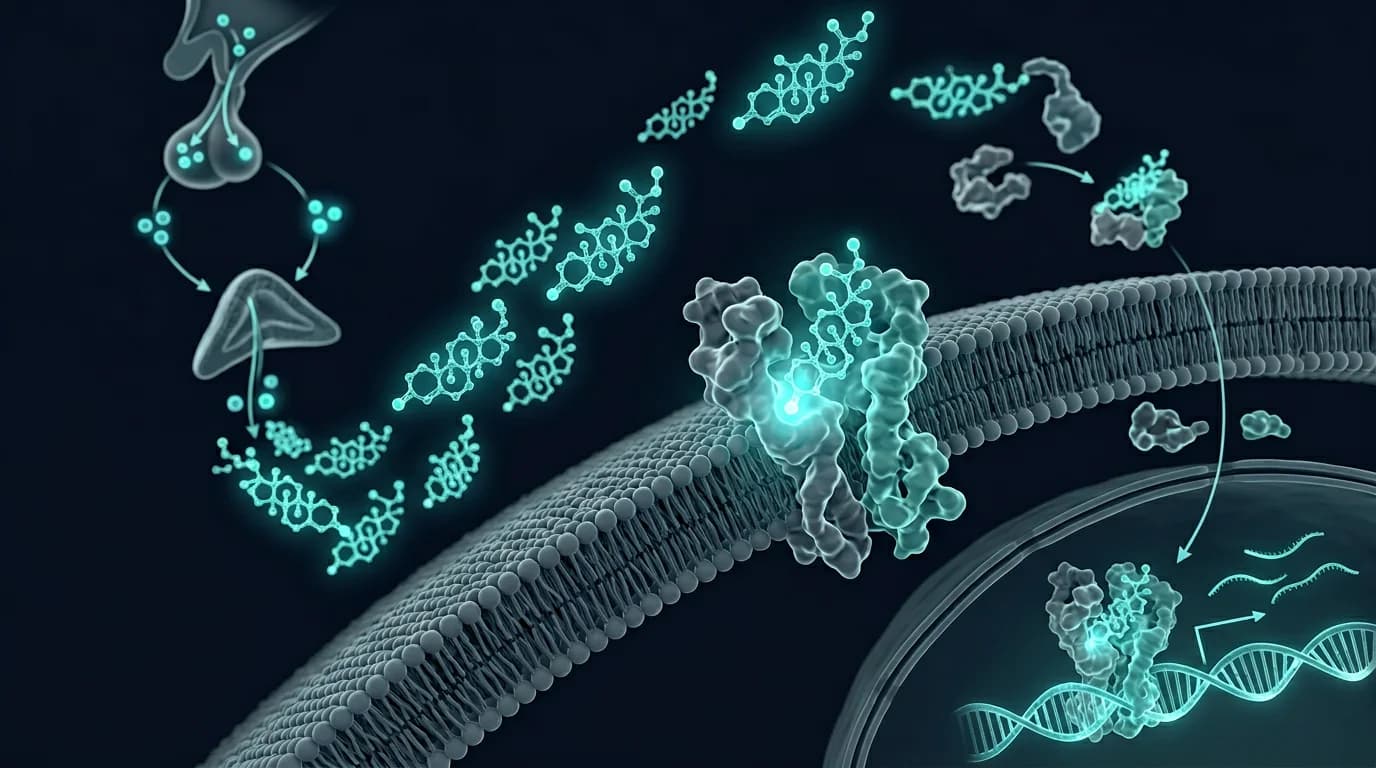
- Penetrate cell membranes and nuclei due to their small size
- Interact with specific DNA sequences in gene promoter regions
- Modulate gene expression in tissue-specific patterns
Pinealon specifically targets the pineal gland and central nervous system. Research suggests it may:
- Enhance melatonin synthesis and secretion
- Support circadian rhythm regulation
- Protect pinealocytes from age-related degeneration
- Provide neuroprotection through antioxidant and anti-apoptotic effects
The key difference from exogenous melatonin is that Pinealon aims to restore the pineal gland's own melatonin production rather than replacing it externally.
For complete details on Pinealon, visit the PepGuide Pinealon profile.
How Pinealon Supports Cortisol Regulation
Pinealon's effects on cortisol appear to operate through the pineal-neuroendocrine connection rather than directly suppressing cortisol production.
Pineal Gland Restoration
The pineal gland serves as a key regulator of circadian rhythms and neuroendocrine function. Khavinson's research suggests Pinealon:
- Enhances melatonin synthesis capacity in pinealocytes
- Protects pineal cells from oxidative damage and calcification
- Restores age-related decline in pineal function
When pineal function improves, the signaling that coordinates circadian cortisol rhythms becomes stronger and more precise.
Circadian Rhythm Optimization
Melatonin is more than a sleep hormone. It serves as a timing signal for the entire neuroendocrine system. Proper melatonin rhythms help:
- Suppress cortisol during evening and night hours
- Allow proper cortisol awakening response in the morning
- Coordinate the timing of other hormone releases
Research in aged animals showed Pinealon administration restored melatonin secretion patterns toward more youthful profiles (Khavinson et al., 2016).
Neuroprotective Effects
Pinealon demonstrates neuroprotective properties that may indirectly support HPA axis function:
- Reduces reactive oxygen species in neural tissue
- Protects against glutamate-induced excitotoxicity
- Supports mitochondrial membrane integrity in neurons
- Modulates calcium signaling
Since the hypothalamus controls both the pineal gland and the HPA axis, protecting hypothalamic neurons may support proper cortisol regulation.
Gene Regulation
At the molecular level, Pinealon appears to modulate expression of over 30 genes in neural tissue. Key upregulated genes include those for:
- Antioxidant defense
- Neurotrophic factors
- Synaptic proteins
This gene-regulatory mechanism may explain why effects persist beyond the peptide's short half-life.
What Real People Are Saying
Pinealon is less commonly discussed than some other peptides, but those exploring bioregulators report interesting effects.
"Pinealon was subtle but real. After two weeks my sleep timing normalized. I stopped needing an alarm - waking up naturally at consistent times. My evening cortisol test improved from 8.2 to 4.1 over 3 months of quarterly cycling." — u/bioregulator_user on r/Peptides
"I stack Pinealon with Epitalon quarterly. The combination seems to help my circadian rhythm more than either alone. Better sleep onset, more consistent wake times, and my afternoon energy crash disappeared." — u/khavinson_protocol on r/Nootropics
"Started Pinealon for the neuroprotective effects but noticed sleep quality improved first. My Oura ring showed more deep sleep percentage and less nighttime waking. I suspect the cortisol connection explains why." — u/longevity_focused on r/Peptides
These reports suggest Pinealon's effects on circadian rhythms may translate to improved cortisol patterns.
Monitoring Your Cortisol Health with FixMyT
Circadian dysfunction and cortisol dysregulation create overlapping symptoms that can be difficult to untangle. Are you fatigued because of high cortisol, low melatonin, poor sleep architecture, or all three?
FixMyT helps visualize these connections through its metabolic tree. The symptoms quiz identifies patterns that suggest cortisol dysfunction and shows how cortisol relates to other nodes like thyroid, gut health, and hormonal balance.
Understanding your metabolic picture is essential because:
- Cortisol dysfunction rarely exists in isolation
- Upstream factors often drive the problem
- Interventions targeting root causes are more effective than symptom suppression
By tracking symptoms over time, you can identify whether interventions are moving the needle on cortisol-related patterns.
Research and Considerations
Pinealon research comes primarily from Khavinson's laboratory at the Saint Petersburg Institute of Bioregulation and Gerontology. While promising, Western validation through independent replication remains limited.
What We Know:
- Pinealon demonstrates direct interaction with DNA sequences in vitro
- Animal studies show restored melatonin secretion patterns
- Neuroprotective effects are documented in cell culture and animal models
- The bioregulator approach has been studied across multiple organ systems for decades
- Khavinson received Russia's State Prize for this work
What Remains Uncertain:
- Direct clinical trial data on cortisol-specific outcomes
- Optimal protocols for circadian-focused use
- Comparative effectiveness versus other interventions
- Long-term effects with quarterly cycling
The bioregulator concept is sophisticated and has theoretical appeal, but the evidence base is primarily preclinical and from Russian-language journals.
Disclaimer
This article is for informational and research purposes only. Pinealon is not approved as a pharmaceutical drug in Western countries. It is available as a dietary bioregulator supplement in Russia.
Nothing in this article constitutes medical advice or a recommendation to use Pinealon. Circadian rhythm disorders and cortisol dysregulation can have significant health implications and warrant professional evaluation.
Before considering any peptide, consult with a qualified healthcare provider. The bioregulator approach is relatively novel in Western contexts.
Learn More
- PepGuide Pinealon Profile - Complete peptide information
- PepGuide Epitalon Profile - Related pineal bioregulator
- FixMyT - Track your metabolic symptoms
References
-
Khavinson VK, Linkova NS, Tarnovskaya SI. "Short Peptides Regulate Gene Expression." Bulletin of Experimental Biology and Medicine. 2016.
-
Khavinson VK. "Peptides and Ageing." Neuroendocrinology Letters. 2002.
-
Anisimov VN, Khavinson VK. "Peptide bioregulation of aging: results and prospects." Biogerontology. 2010.
-
Khavinson VK, et al. "Pinealon increases cell viability by suppression of free radical levels and activating proliferative processes." Rejuvenation Research. 2011.
-
Khavinson VK, Malinin VV. "Gerontological Aspects of Genome Peptide Regulation." Basel: Karger. 2005.