Introduction
The pineal gland may be small, but its influence on hormonal health is profound. This pea-sized structure in your brain produces melatonin -- the hormone that orchestrates your circadian rhythm and, by extension, the timing of virtually every other hormone in your body. When pineal function declines, the entire hormonal symphony falls out of tune.
Pinealon is a synthetic tripeptide bioregulator developed by Professor Vladimir Khavinson at the Saint Petersburg Institute of Bioregulation and Gerontology. It specifically targets the pineal gland and central nervous system, aiming to restore optimal function to these regulatory systems.
The connection to progesterone is rooted in circadian biology. Progesterone production follows circadian patterns, and disrupted circadian signaling impairs the entire steroidogenic cascade. By supporting pineal function and circadian regulation, Pinealon may create the neuroendocrine conditions necessary for healthy progesterone expression.
In this article, you will learn how circadian rhythms affect progesterone, why pineal health matters for hormonal balance, and how FixMyT can help you understand whether circadian disruption is affecting your metabolic tree.
Understanding Progesterone: The Protection of Your Metabolism
Progesterone sits at Level 4 of the FixMyT metabolic tree under the banner of "Protection." This is not mere metaphor -- progesterone genuinely protects against several metabolic imbalances that can derail male health.
The protective functions of progesterone include:
- Estrogen opposition: Counteracts estrogenic effects on tissues
- 5-alpha reductase modulation: Influences DHT production pathways
- Neurosteroid activity: Metabolizes to calming compounds like allopregnanolone
- Thyroid support: Enhances tissue sensitivity to thyroid hormones
- Anti-inflammatory effects: Modulates inflammatory signaling
When progesterone is insufficient, the symptoms often appear as anxiety, disrupted sleep, estrogen-dominant presentations, and reduced stress resilience. Many of these symptoms overlap with circadian disruption -- and this is no coincidence. The circadian system and progesterone production are intimately linked.
The upstream regulatory systems matter: if your circadian rhythm is off, your cortisol pattern is off. If your cortisol pattern is off, progesterone production suffers. This cascade begins at the pineal gland.
What Is Pinealon?
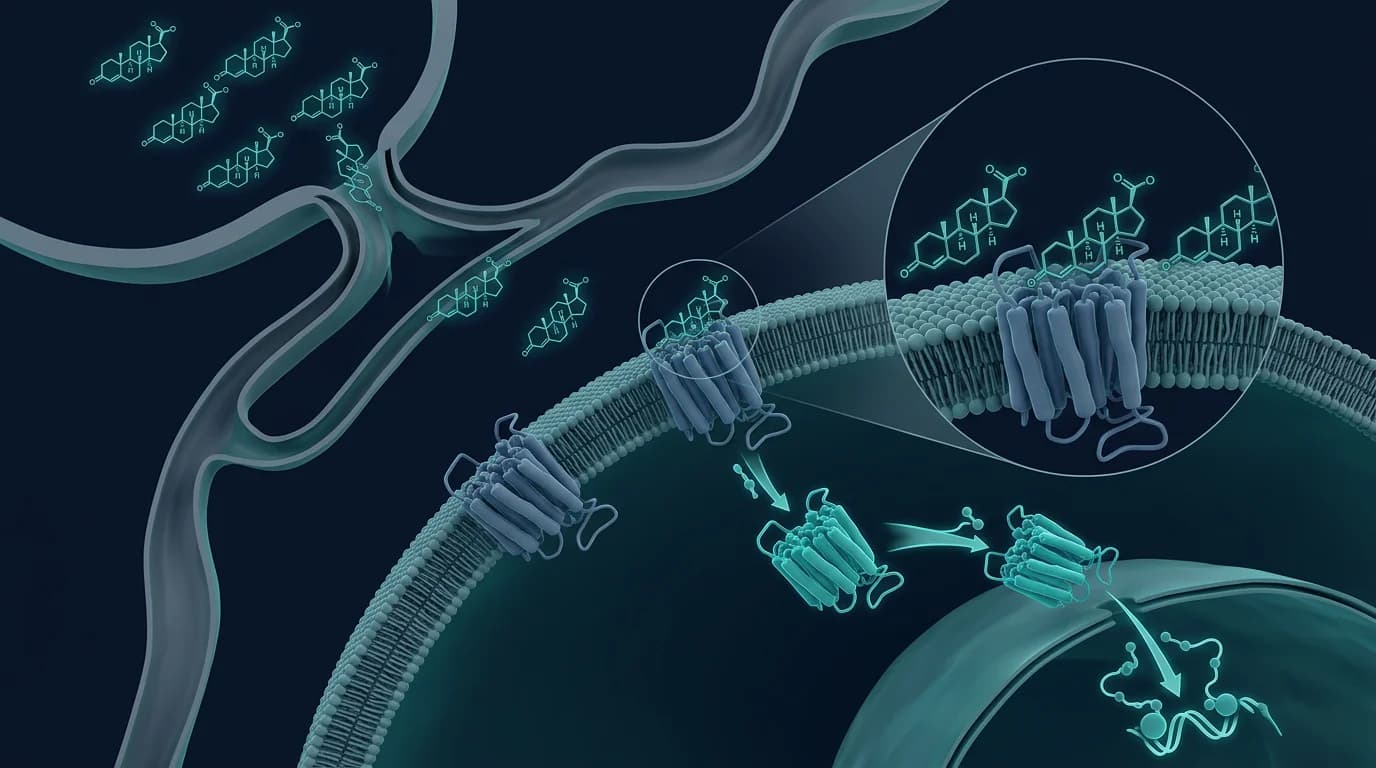
Pinealon is a tripeptide with the sequence Glu-Asp-Arg (EDR), developed as part of Khavinson's bioregulator research program. The Khavinson approach proposes that specific short peptides can interact with DNA and gene promoter regions to regulate protein synthesis in their target tissues.
Key characteristics of Pinealon:
- Sequence: Glu-Asp-Arg (3 amino acids)
- Molecular weight: 418.40 g/mol
- Classification: Peptide bioregulator / Neuroprotective agent
- Target tissue: Pineal gland and CNS
- Administration: Oral (10 mg) or sublingual
- Research status: Available as supplement in Russia; research compound elsewhere
What makes Pinealon interesting is its proposed mechanism: rather than flooding the system with a hormone, it may modulate gene expression in pineal tissue to restore natural function. This epigenetic approach is characteristic of Khavinson bioregulators and distinguishes them from direct hormone replacement.
For the complete technical profile, see the full Pinealon profile on PepGuide.
How Pinealon Supports Progesterone Function
The relationship between Pinealon and progesterone operates through the neuroendocrine regulatory system, with the pineal gland as a key orchestrator.
1. Circadian Rhythm Restoration
The pineal gland produces melatonin in response to darkness, establishing the master circadian signal:
- Melatonin peaks at night, signaling "rest and repair" mode
- This signal coordinates the timing of cortisol (lowest at night), growth hormone (peaks during sleep), and steroid hormones
- Progesterone synthesis follows circadian patterns aligned with this system
Animal studies show that Pinealon restores melatonin secretion patterns in aged animals, suggesting it may help re-establish the circadian signaling necessary for proper hormone timing.
2. Neuroendocrine Cascade Support
The pineal gland communicates with the hypothalamus and pituitary, which together regulate steroid hormone production:
- Hypothalamic GnRH pulses (which drive LH/FSH and ultimately steroid production) are influenced by circadian inputs
- Disrupted pineal function can alter the pulsatile patterns of upstream hormones
- By supporting pineal health, Pinealon may help restore normal neuroendocrine cascade function
This is particularly relevant for progesterone because its production depends on appropriate LH signaling to gonadal tissue.
3. Neuroprotection and Stress Modulation
Pinealon has demonstrated neuroprotective properties in research:
- Reduces reactive oxygen species in neural tissue
- Protects against glutamate-induced excitotoxicity
- Modulates neuroinflammatory markers
- Supports mitochondrial function in neurons
A protected, well-functioning nervous system is better equipped to regulate the stress response appropriately. Since excessive stress signaling suppresses progesterone (through the pregnenolone steal mechanism), neuroprotection indirectly supports steroidogenesis.
4. Gene Expression Modulation
Khavinson's research suggests short peptides like Pinealon can influence gene expression at the epigenetic level:
- May modulate transcription of genes involved in circadian regulation
- Could affect expression of neuroprotective and neurotrophic factors
- Tissue-specific effects focused on CNS and pineal function
While this mechanism is more speculative than the established pharmacology of other peptides, it represents an interesting theoretical framework for how Pinealon might influence downstream hormonal function.
What Real People Are Saying
The peptide bioregulator community, while smaller than the broader peptide community, has shared observations about Pinealon:
"I've been using Pinealon as part of a Khavinson bioregulator protocol for about 6 months. The most noticeable effect is on my sleep quality and circadian rhythm. I fall asleep more easily, wake up more refreshed, and my morning energy is much better. Labs show improved cortisol rhythm and my pregnenolone has come up." -- u/bioregulator_research on r/Peptides
"Pinealon combined with Epitalon has been my anti-aging stack. The circadian effects are real -- my HRV improved, sleep scores went up, and I feel like my hormones are running on a better schedule. Hard to isolate which peptide is doing what, but the combination is working." -- u/longevity_hacker on r/Nootropics
"Started Pinealon for neuroprotection but noticed my sleep and mood improved significantly. My stress tolerance is better and I feel more hormonally stable throughout the day. Haven't measured progesterone specifically but the overall pattern is better." -- u/neuro_optimization on r/Biohackers
These are anecdotal reports from individuals experimenting with bioregulator protocols. The Khavinson bioregulator framework remains more established in Russian medicine than Western practice, and individual experiences vary significantly.
Monitoring Your Progesterone Health with FixMyT
Circadian disruption often underlies hormonal imbalances that seem otherwise mysterious. FixMyT provides a framework for understanding how circadian and neuroendocrine factors affect your Progesterone node.
The FixMyT symptoms quiz evaluates indicators relevant to circadian-hormone connections:
- Difficulty with sleep timing (delayed sleep onset, early waking)
- Inconsistent energy patterns throughout the day
- Afternoon crashes or evening second winds
- Mood instability that follows time-of-day patterns
- Stress responses that seem disproportionate
The visual metabolic tree maps the relationships between upstream factors (including cortisol patterns and sleep quality) and downstream hormone expression. If multiple upstream nodes show dysfunction, addressing circadian regulation may have cascading benefits throughout the tree.
For those researching bioregulators like Pinealon, FixMyT provides context about whether circadian and neuroendocrine optimization is a high-priority target.
Research and Considerations
Pinealon research comes primarily from Russian institutions, with Khavinson's laboratory at the Saint Petersburg Institute producing the majority of publications. While preclinical data is promising, Western peer-reviewed validation remains limited.
What the evidence supports:
- Short peptides can cross cell membranes and potentially influence gene expression (mechanistic studies)
- Pinealon protects neurons against oxidative stress in cell culture
- Improved cognitive performance in aged animal models
- Restored circadian melatonin rhythm in aged animals
- Part of comprehensive bioregulator protocols studied in elderly populations
What needs more research:
- Direct human studies on Pinealon specifically (most studies are combined with other bioregulators)
- Validation of the gene expression mechanism in independent laboratories
- Effects on specific steroid hormones including progesterone
- Long-term safety and efficacy data in Western clinical contexts
The bioregulator concept is intellectually interesting but requires more rigorous validation to meet Western evidence standards. For those comfortable with earlier-stage research, Pinealon represents an intriguing approach to circadian and neuroendocrine support.
Disclaimer
This article is for educational and research purposes only. Pinealon is available as a supplement in Russia but is not approved as a drug in Western countries. Nothing in this article constitutes medical advice or a recommendation to use any substance.
The bioregulator framework represents one theoretical approach to peptide therapy and is not universally accepted in Western medicine. If you are experiencing circadian disruption, sleep disorders, or hormonal imbalances, consult with a qualified healthcare provider.
Any decisions about health interventions remain your responsibility in consultation with appropriate medical professionals.
Learn More
- Full Pinealon Profile on PepGuide - Complete technical details and background
- Epitalon for Circadian Support - Complementary Khavinson bioregulator
- FixMyT Metabolic Assessment - Understand your circadian-hormone connections
- DSIP for Sleep-Based Hormone Support - Alternative peptide approach to sleep optimization
References
-
Khavinson VK, Linkova NS, Tarnovskaya SI. "Short Peptides Regulate Gene Expression." Bulletin of Experimental Biology and Medicine. 2016;160(6):757-760.
-
Khavinson VK, et al. "Pinealon increases cell viability by suppression of free radical levels and activating proliferative processes." Rejuvenation Research. 2011;14(5):535-541.
-
Anisimov VN, Khavinson VK. "Peptide bioregulation of aging: results and prospects." Biogerontology. 2010;11(2):139-149.
-
Khavinson VK, Malinin VV. Gerontological Aspects of Genome Peptide Regulation. Basel: Karger; 2005.
-
Pevet P, Challet E. "Melatonin: both master clock output and internal time-giver in the circadian clocks network." Journal of Physiology-Paris. 2011;105(4-6):170-182.