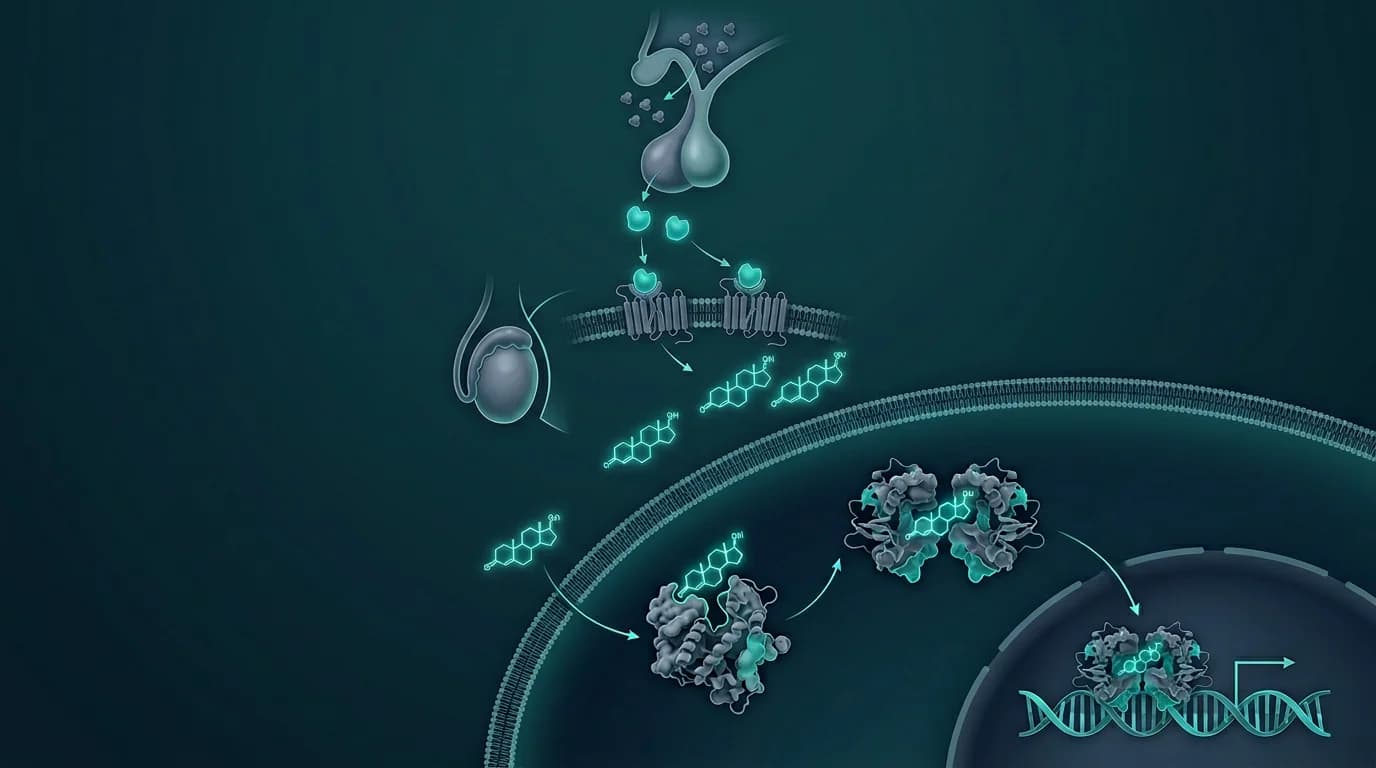
Introduction
Sleep is not optional for testosterone. It is the factory floor where testosterone production peaks. During deep delta-wave sleep, testosterone synthesis reaches its maximum, and disrupted sleep directly translates to lower testosterone levels. Studies show that just one week of sleep restriction (5 hours per night) can reduce testosterone by 10-15%.
Delta Sleep-Inducing Peptide (DSIP) addresses this relationship directly. Discovered in 1977, DSIP promotes slow-wave (delta) sleep -- the exact sleep stage where testosterone production peaks. Unlike sedatives that knock you unconscious, DSIP appears to optimize sleep architecture, increasing the restorative phases where hormone production thrives.
In this article, you will learn how sleep quality controls testosterone production, why DSIP's mechanism makes it relevant for hormonal optimization, and how FixMyT helps you understand whether sleep issues are undermining your testosterone expression.
Understanding Testosterone: The Expression of Your Metabolism
Testosterone sits at the apex of the FixMyT metabolic tree, representing the final output of Level 4: Androgen Expression. The subtitle "Expression" reflects that testosterone is the culmination of everything working properly upstream.
The FixMyT framework shows testosterone depending on:
- Nutrition and Mitochondria (Level 1): Raw materials and cellular energy
- Gut, Liver, Thyroid (Level 2): Hormone processing and activation
- Low Cortisol/Estrogen/Prolactin/Serotonin (Level 3): Minimal interference
- Progesterone and DHT (Level 4): Supportive environment
When testosterone is low, symptoms cascade: fatigue, low libido, muscle loss, fat accumulation, brain fog, and depression. But here is the often-overlooked factor: sleep quality is upstream of everything. Poor sleep:
- Elevates cortisol (Level 3 interference)
- Disrupts the nocturnal hormone production window
- Increases inflammatory signaling
- Impairs metabolic function at every level
This is why sleep optimization is often the highest-leverage intervention for testosterone.
What Is DSIP?
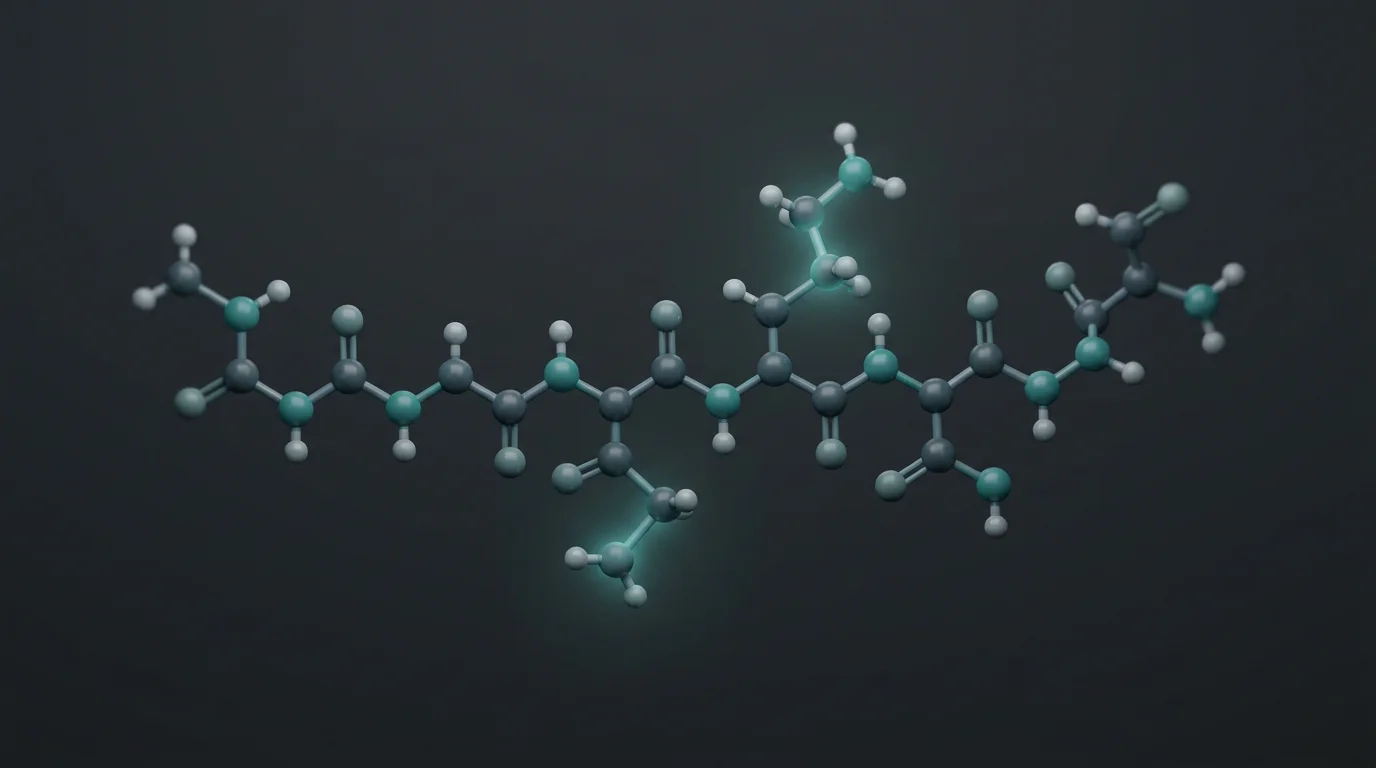
Delta Sleep-Inducing Peptide is a naturally occurring nonapeptide first isolated from rabbit cerebral venous blood during induced sleep. It was discovered by Swiss researchers in 1977 and named for its most prominent effect.
Key characteristics of DSIP:
- Sequence: Trp-Ala-Gly-Gly-Asp-Ala-Ser-Gly-Glu (9 amino acids)
- Molecular weight: 848.81 g/mol
- Classification: Neuromodulatory peptide
- Administration: Subcutaneous (100-300 mcg before bed)
- Half-life: 15-25 minutes (but effects persist for hours)
- Research status: Limited human studies; primarily preclinical
DSIP does not act as a sedative. Rather than forcing unconsciousness, it appears to modify sleep architecture -- promoting the slow-wave (delta) sleep stages where the body does its deepest repair and hormone production.
For the complete technical profile, see the full DSIP profile on PepGuide.
How DSIP Supports Testosterone Function
DSIP's support for testosterone operates through its effects on sleep quality and stress physiology:
1. Delta Sleep Promotion
DSIP specifically enhances slow-wave sleep (Stages 3-4 NREM):
- This is when testosterone production peaks
- GH secretion is also highest during delta sleep
- Cortisol reaches its lowest point
- The body shifts to full repair/production mode
Research demonstrated measurable increases in delta wave power during DSIP-enhanced sleep.
2. Nocturnal Testosterone Production
Testosterone follows a circadian pattern:
- Peaks in early morning (around 7-8 AM)
- Results from production during deep sleep overnight
- Disrupted sleep flattens this curve
- Sleep deprivation directly reduces testosterone
By enhancing deep sleep, DSIP creates optimal conditions for nocturnal testosterone synthesis.
3. Cortisol Modulation
DSIP has demonstrated effects on the HPA axis:
- Attenuates cortisol output under stress
- Normalizes circadian cortisol patterns
- Reduces the stress response
Lower cortisol means less interference with testosterone production (cortisol and testosterone have an inverse relationship) and less pregnenolone steal.
4. LH Pulsatility Support
Deep sleep affects LH secretion:
- LH pulses drive testicular testosterone production
- Sleep architecture affects LH pulse patterns
- Better sleep may support more robust LH signaling
- The downstream effect is improved testosterone output
5. Recovery and Repair
Deep sleep is when the body repairs itself:
- Protein synthesis peaks
- Cellular repair processes accelerate
- Inflammatory markers decrease
- The metabolic environment shifts toward anabolism
This anabolic environment supports testosterone production and action.
What Real People Are Saying
The peptide community has shared experiences connecting DSIP use with improved sleep and testosterone:
"DSIP completely transformed my sleep quality. I'm getting into deep sleep faster and staying there according to my Whoop data. After about 2 months, my morning testosterone jumped from 450 to 580 -- no other changes. The sleep was clearly the limiting factor." -- u/sleep_testosterone_link on r/Peptides
"Been using DSIP 200mcg every other night. The sleep architecture improvement is real -- more REM, more deep sleep, less waking. My cortisol:testosterone ratio has improved significantly. I'm finally getting the restorative sleep that supports hormone production." -- u/circadian_optimization on r/Testosterone
"Added DSIP to my protocol specifically for sleep. The effect on testosterone was secondary but notable -- about 12% improvement over baseline. Makes sense when you realize that's when testosterone is made. Better sleep = better hormones, simple as that." -- u/hormone_sleep_connection on r/MorePlatesMoreDates
These experiences reflect community observations. Individual responses vary.
Monitoring Your Testosterone Health with FixMyT
Understanding how sleep affects your testosterone requires mapping the full picture. FixMyT provides this comprehensive assessment.
The FixMyT symptoms quiz evaluates:
- Sleep quality indicators
- Testosterone symptoms (energy, libido, muscle, mood)
- Cortisol and stress indicators
- Overall metabolic function
The visual metabolic tree shows how testosterone at Level 4 depends on everything upstream. If your cortisol node at Level 3 is flagged (often due to poor sleep), addressing sleep may be the highest-leverage intervention for testosterone.
For those researching sleep peptides like DSIP, FixMyT helps identify whether sleep optimization is a priority target.
Research and Considerations
DSIP research peaked in the 1980s and 1990s, with the peptide's short half-life presenting pharmaceutical development challenges.
What the evidence supports:
- DSIP increases delta wave activity during sleep (demonstrated)
- Deep sleep is when testosterone production peaks (well-established)
- Sleep deprivation directly reduces testosterone (proven in studies)
- DSIP modulates cortisol and stress responses (shown in research)
- Good tolerability profile
What needs more research:
- Direct studies measuring testosterone changes during DSIP protocols
- Long-term effects on the HPG axis
- Optimal dosing specifically for hormone optimization
- Comparison with other sleep interventions
The mechanistic logic is sound; direct clinical evidence specific to testosterone is limited.
Disclaimer
This article is for educational and research purposes only. DSIP is not approved for human use by the FDA or other regulatory agencies. Nothing in this article constitutes medical advice or a recommendation to use any substance.
If you are experiencing sleep disorders or low testosterone, consult with a qualified healthcare provider. Established sleep hygiene practices and addressing underlying conditions may be more appropriate first-line interventions.
Any decisions about health interventions remain your responsibility in consultation with appropriate medical professionals.
Learn More
- Full DSIP Profile on PepGuide - Complete technical details
- Selank for Stress Reduction - Addressing cortisol interference
- FixMyT Metabolic Assessment - Understand sleep-hormone connections
- Ipamorelin + CJC for GH - Another sleep-enhancing approach
References
-
Leproult R, Van Cauter E. "Effect of 1 week of sleep restriction on testosterone levels in young healthy men." JAMA. 2011;305(21):2173-2174.
-
Luboshitzky R, et al. "Disruption of the nocturnal testosterone rhythm by sleep fragmentation in normal men." Journal of Clinical Endocrinology & Metabolism. 2001;86(3):1134-1139.
-
Schneider-Helmert D, Schoenenberger GA. "Effects of DSIP in man. Multifunctional psychophysiological properties besides induction of natural sleep." Neuropsychobiology. 1983;9:197-206.
-
Graf MV, Kastin AJ. "Delta-sleep-inducing peptide (DSIP): a review." Neuroscience & Biobehavioral Reviews. 1984;8(1):83-93.
-
Penev PD. "Association between sleep and morning testosterone levels in older men." Sleep. 2007;30(4):427-432.