Introduction
Peptides are biologically active molecules that can lose potency or become inactive if stored improperly. Unlike many pharmaceutical compounds that remain stable at room temperature for years, peptides require careful attention to temperature, light exposure, moisture, and contamination to maintain their integrity.
Whether managing a laboratory inventory or learning about peptide handling for the first time, proper storage is one of the most important factors in ensuring that peptides remain effective throughout their intended shelf life. This guide covers everything researchers need to know about peptide storage, from the moment a lyophilized vial is received to the final dose of a reconstituted solution.
Disclaimer: This article is for educational purposes only. Peptide handling should only be performed by qualified individuals in appropriate settings. Many peptides discussed are not approved for human use. Always consult a healthcare provider.
Understanding Peptide Forms
Before discussing storage, it is essential to understand the two primary forms in which peptides are encountered:
Lyophilized (Freeze-Dried) Powder
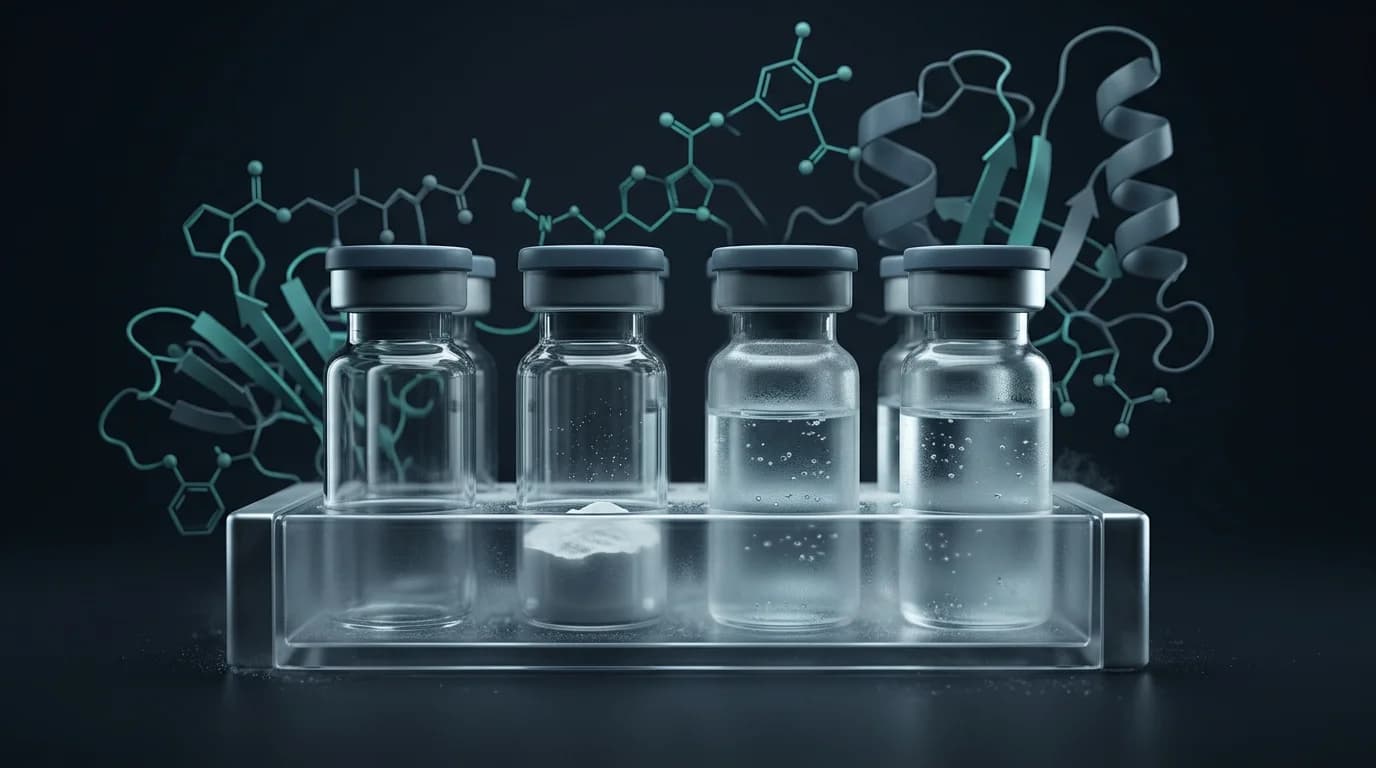
Lyophilization is a process that removes water from the peptide solution while preserving its molecular structure. The result is a dry, fluffy powder or compact pellet (often called a "puck") at the bottom of a sealed vial.
Key characteristics:
- Most stable form for long-term storage
- Protected from hydrolysis (water-mediated degradation)
- Typically arrives sealed under vacuum or inert gas
- Appearance ranges from white to off-white powder
- Some peptides may appear as a thin film on the vial wall
Reconstituted (Liquid) Solution
Once bacteriostatic water or another solvent is added to the lyophilized powder, the peptide is in solution. This reconstituted form is necessary for accurate dosing but is significantly less stable than the dry powder.
Key characteristics:
- Active form ready for dosing
- Subject to hydrolysis, oxidation, and microbial contamination
- Much shorter shelf life than lyophilized form
- Must be refrigerated immediately after preparation
Rule of Thumb: Keep peptides in lyophilized form as long as possible. Only reconstitute what the research protocol requires within the recommended timeframe (typically 14-28 days).
Temperature Requirements
Temperature is the single most important factor in peptide storage. Heat accelerates chemical degradation, while freezing can help preserve structure in the dry state but may damage reconstituted solutions.
Lyophilized Peptide Storage
| Temperature | Duration | Best For |
|---|---|---|
| -20°C (-4°F) Freezer | 12-24 months | Long-term storage |
| 2-8°C (36-46°F) Refrigerator | 3-6 months | Medium-term storage |
| Room temperature (20-25°C) | 1-3 months | Short-term / transit |
| Above 30°C (86°F) | Days to weeks | Avoid entirely |
Recommendations:
- Store bulk inventory in a freezer at -20°C for maximum shelf life
- Move vials to the refrigerator when planning to use them within the next few months
- Brief exposure to room temperature (during shipping or handling) is generally acceptable
- Never leave lyophilized peptides in direct sunlight or near heat sources
Reconstituted Peptide Storage
| Temperature | Duration | Notes |
|---|---|---|
| 2-8°C (36-46°F) Refrigerator | 14-28 days* | Standard recommendation |
| Room temperature | Hours only | Not recommended for storage |
| Freezer | Not recommended | Can cause precipitation and denaturation |
*Duration varies significantly by peptide. Some specific guidelines:
| Peptide | Reconstituted Stability | Notes |
|---|---|---|
| BPC-157 | 14-28 days | Very stable in solution |
| TB-500 | 8-10 days | Less stable; reconstitute smaller amounts |
| Ipamorelin | 21-28 days | Standard stability |
| CJC-1295 | 21-28 days | Standard stability |
| Semaglutide | 56 days | Exceptionally stable (manufacturer pens) |
| Semax | 7-14 days | Less stable; use quickly |
Critical Warning: Never freeze reconstituted peptides. Freezing can cause the peptide to precipitate out of solution, form aggregates, or undergo structural changes that reduce or eliminate biological activity. If particles or cloudiness appear in a previously clear solution, discard it.
Temperature Fluctuations
Repeated temperature cycling (moving between cold and warm environments) is particularly damaging to both forms:
- Lyophilized: Each warm cycle introduces moisture through condensation, which can initiate hydrolysis even in the "dry" powder
- Reconstituted: Temperature changes accelerate degradation and can promote bacterial growth
Best practice: Decide where a vial will be stored and leave it there. Avoid repeatedly moving vials between the refrigerator and room temperature.
Light Sensitivity
Many peptides are sensitive to light, particularly ultraviolet (UV) light. Light exposure can trigger oxidation of certain amino acid residues (especially tryptophan, tyrosine, and methionine), leading to structural changes and loss of potency.
Which Peptides Are Most Light-Sensitive?
| Sensitivity Level | Peptides | Precaution |
|---|---|---|
| High | Melanotan II, PT-141 | Store in amber vials, minimize light exposure |
| Moderate | Most peptides | Keep in original vial, store in dark location |
| Low | BPC-157, Semaglutide | Normal precautions sufficient |
Light Protection Strategies
- Keep vials in their original packaging until ready for use -- boxes and foil pouches block light
- Store in a dark location -- the back of a refrigerator is ideal (door shelves experience more light)
- Use amber vials for light-sensitive peptides if available
- Wrap vials in aluminum foil as a simple light barrier if amber vials are unavailable
- Minimize time outside storage -- draw the required dose and return the vial immediately
Moisture and Humidity
The Enemy of Lyophilized Peptides
The entire purpose of lyophilization is to remove water and prevent hydrolysis. Moisture exposure reverses this protection:
- Humidity in the air can be absorbed through imperfect vial seals
- Condensation forms when cold vials are opened in warm, humid environments
- Even small amounts of moisture can initiate degradation over time
Protection Measures
- Allow vials to reach room temperature before opening -- this prevents condensation from forming on the cold powder when exposed to ambient air
- Store in a low-humidity environment -- consider using desiccant packets in the storage container
- Reseal vials promptly after drawing from them
- Use proper aseptic technique to avoid introducing moisture during reconstitution
Temperature Equilibration Tip: When removing a lyophilized vial from the freezer, allow it to sit at room temperature for 15-20 minutes before opening. This prevents condensation from forming on the cold powder, which would introduce unwanted moisture.
Container Considerations
Vial Types
| Vial Type | Advantages | Disadvantages |
|---|---|---|
| Clear glass | Easy to inspect contents | No light protection |
| Amber glass | UV protection | Harder to inspect solution clarity |
| Plastic (polypropylene) | Lightweight, shatter-resistant | Some peptides may adsorb to plastic |
Seal Integrity
The rubber stopper and aluminum crimp cap on peptide vials serve as the primary barrier against contamination and moisture:
- Do not remove the rubber stopper -- always access vials through the stopper with a needle
- Inspect the crimp cap upon receipt -- loose or damaged caps may indicate compromised contents
- Multiple needle punctures degrade the stopper over time -- after 20+ punctures, the seal may no longer be reliable
- Consider aliquoting large vials into smaller ones to reduce the number of punctures per vial
Common Storage Mistakes
Mistake 1: Storing Reconstituted Peptides at Room Temperature
Leaving a reconstituted vial on the counter, even for a few hours, accelerates degradation exponentially. Bacteria thrive at room temperature, and chemical degradation rates roughly double with every 10°C increase.
Fix: Return vials to the refrigerator immediately after drawing each dose.
Mistake 2: Freezing Reconstituted Solutions
Some people assume that if cold is good, colder must be better. Freezing reconstituted peptides can cause:
- Ice crystal formation that physically disrupts peptide structure
- Concentration effects at the ice-liquid boundary that denature proteins
- Precipitation that may not fully redissolve upon thawing
Fix: Only freeze lyophilized (dry) peptides. Keep reconstituted solutions refrigerated at 2-8°C.
Mistake 3: Reconstituting Too Much at Once
If a large vial is reconstituted and only a small amount is used per day, the recommended storage duration may be exceeded before finishing the vial.
Fix: Calculate how much the research protocol requires within 14-28 days and only reconstitute that amount. If a vial contains more than needed, consider splitting the powder between two vials before adding solvent (though this introduces contamination risk and requires careful technique).
Mistake 4: Not Labeling Vials
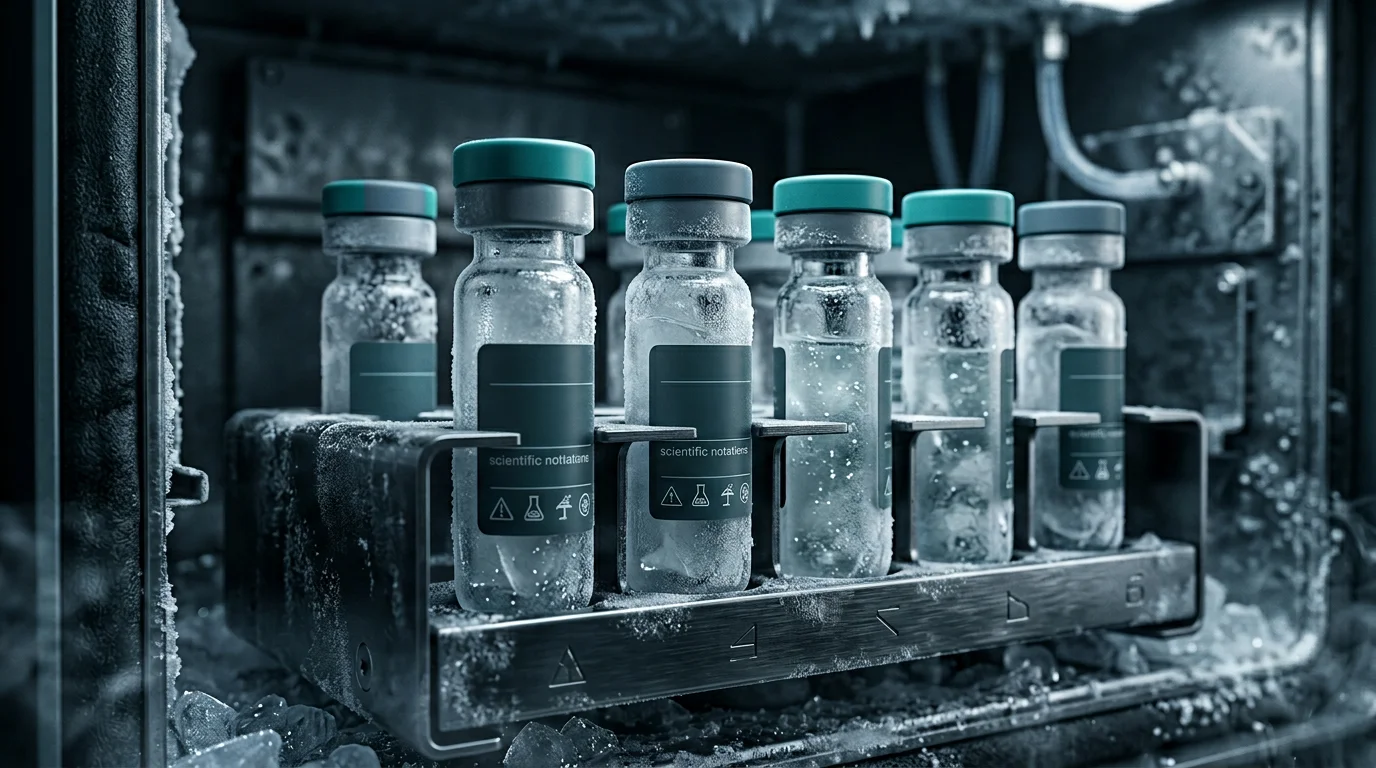
Once reconstituted, all peptide solutions look the same -- clear liquid in a small vial. Without labels, mix-ups are inevitable.
Fix: Label every reconstituted vial with:
- Peptide name
- Concentration (mcg per unit or mg/mL)
- Reconstitution date
- Expiration date (reconstitution date + recommended duration)
Mistake 5: Ignoring Expiration Dates
Peptides do not suddenly become toxic on their expiration date, but potency gradually decreases. Using expired peptides means research subjects may be receiving less active compound than intended, leading to inconsistent results.
Fix: Track reconstitution dates and discard vials that exceed the recommended storage duration. When in doubt, discard.
Mistake 6: Exposing Cold Vials to Warm Air
Taking a vial from the freezer and immediately opening it in a warm room causes condensation on the cold surfaces, including the peptide powder.
Fix: Allow 15-20 minutes for the sealed vial to reach room temperature before opening or puncturing the stopper.
Traveling with Peptides
Traveling presents unique storage challenges. Here are guidelines for maintaining peptide integrity during transit:
Short Trips (1-3 Days)
For lyophilized peptides:
- Room temperature exposure for 1-3 days is generally acceptable
- Keep vials in original packaging in a cool part of luggage
- Avoid checked luggage in hot weather (cargo holds can exceed 40°C on the tarmac)
For reconstituted peptides:
- Use an insulated bag with ice packs or gel packs
- Maintain 2-8°C range as closely as possible
- A small cooler bag with a frozen gel pack works well for 6-12 hours
- Consider medical-grade travel coolers for longer trips
Extended Travel (4+ Days)
- Bring lyophilized peptides when possible and reconstitute at the destination
- If reconstituted peptides must be transported, invest in a medical-grade portable cooler
- Some hotels offer mini-fridges (check in advance)
- Ask hotel staff to store vials in their kitchen refrigerator if no mini-fridge is available
Air Travel Considerations
- Peptide vials may be flagged during security screening -- carry documentation if available
- Insulin-type syringes are generally permitted on aircraft (carry a note from the research subject's healthcare provider)
- Pressure changes in aircraft cabins are minimal and should not affect sealed vials
- TSA and most international security agencies allow liquid medications under 100mL with documentation
- Consider carrying a brief letter from a healthcare provider explaining the research purpose
Travel Tip: Lyophilized peptides are far more practical for travel. They are stable at room temperature for weeks, lightweight, and do not require cold chain logistics. If the research protocol allows, time reconstitution to coincide with travel -- bring dry vials and BAC water, and reconstitute upon arrival.
Temperature Monitoring
For high-value peptide shipments or critical travel situations:
- Min/max thermometers: Inexpensive devices that record the lowest and highest temperature during transit
- Temperature indicator strips: Single-use strips that change color if temperature exceeds a threshold
- Data loggers: Electronic devices that record temperature at intervals for later review
Building a Home Storage System
Basic Setup
A reliable home storage system does not require expensive equipment:
-
Dedicated refrigerator space: Designate a specific area in the refrigerator for peptide storage. The back of a shelf (not the door) offers the most stable temperature.
-
Small opaque container: Place vials in a small box or container inside the refrigerator. This provides:
- Light protection
- Organization
- A buffer against temperature fluctuations when the door opens
-
Labels and tracking: Use a simple spreadsheet or notebook to track:
- Peptide name
- Amount per vial
- Reconstitution date
- Solvent used and volume
- Calculated concentration
- Expected expiration date
Advanced Setup
For researchers or those managing multiple peptides:
- Dedicated mini-fridge: A small, temperature-controlled unit set to 4°C provides more consistent temperatures than a household refrigerator that is opened frequently
- Freezer storage unit: A dedicated freezer at -20°C for long-term lyophilized storage
- Desiccant packs: Silica gel packets inside storage containers absorb residual moisture
- Temperature monitoring: A thermometer with min/max recording capability inside the storage unit
Quality Indicators
Signs of Degraded Peptides
Learn to recognize when a peptide may have been compromised:
Lyophilized peptides -- warning signs:
- Powder has turned dark yellow or brown (should be white to off-white)
- Powder appears wet or clumped
- Vial seal is broken or loose
- Vial has been exposed to extreme heat
Reconstituted peptides -- warning signs:
- Solution is cloudy or has visible particles (should be clear)
- Solution has changed color significantly
- Unusual odor (peptide solutions should be largely odorless)
- Solution was left at room temperature for extended periods
- Reconstitution date exceeds recommended storage duration
Safety First: If any signs of degradation are observed, discard the vial. Using degraded peptides may result in reduced efficacy, unexpected side effects, or infection risk from contaminated solutions. When in doubt, discard and prepare fresh.
Summary: Quick Reference Storage Chart
| Form | Temperature | Duration | Light | Key Precaution |
|---|---|---|---|---|
| Lyophilized | -20°C (freezer) | 12-24 months | Low concern | Allow to reach room temp before opening |
| Lyophilized | 2-8°C (fridge) | 3-6 months | Keep in box | Avoid humidity |
| Lyophilized | Room temp | 1-3 months | Keep in box | Acceptable for transit |
| Reconstituted | 2-8°C (fridge) | 14-28 days* | Protect from light | Never freeze |
| Reconstituted | Room temp | Hours only | N/A | Return to fridge immediately |
*Varies by peptide -- check specific guidelines
Key Takeaways
- Lyophilized is king: Keep peptides in freeze-dried form as long as possible for maximum shelf life
- Temperature is critical: Refrigerate reconstituted peptides at 2-8°C; freeze lyophilized peptides at -20°C for long-term storage
- Never freeze reconstituted peptides: This causes structural damage that cannot be reversed
- Protect from light: Store in dark locations, use amber vials, or wrap in foil
- Avoid moisture: Let cold vials equilibrate to room temperature before opening
- Label everything: Date, name, and concentration on every reconstituted vial
- Track expiration: Discard reconstituted peptides after the recommended timeframe
- Travel smart: Lyophilized peptides are best for travel; use insulated bags for reconstituted solutions
Related Resources
- Complete Guide to Peptide Reconstitution - Step-by-step reconstitution instructions
- Understanding Half-Lives and Dosing - How timing affects peptide effectiveness
- Getting Started with Peptides - Beginner's overview
- Peptide Safety: What the Research Says - Comprehensive safety information
- Peptide Calculator - Calculate reconstitution volumes and doses