
Introduction
Selecting a reliable peptide source is one of the most critical decisions in research. Unlike pharmaceutical drugs, research peptides exist in a largely unregulated market where quality can vary dramatically between vendors. Poor quality peptides can lead to invalid research results, wasted resources, and potential safety concerns.
This guide provides a comprehensive framework for evaluating peptide vendors and sources, helping researchers make informed decisions based on objective quality indicators rather than marketing claims.
Research Use Only: This guide is for educational purposes. Research peptides are not approved for human consumption. The information provided helps researchers evaluate sources for legitimate research applications only.
Why Source Quality Matters
Research Integrity
Poor quality peptides compromise research outcomes through:
- Underdosing - Less active compound than claimed
- Contamination - Presence of harmful substances
- Wrong compound - Mislabeled or substituted peptides
- Degradation - Improperly stored or handled materials
- Inconsistency - Batch-to-batch variation
Financial Impact
| Issue | Cost Impact |
|---|---|
| Invalid results | Wasted time and materials |
| Need to repeat experiments | Double the resource investment |
| Lost research opportunities | Delayed timelines |
| Health/safety issues | Potential liability and medical costs |
The Unregulated Market Reality
The research peptide market operates with minimal oversight:
- No FDA approval process for research compounds
- No standardized quality requirements
- No mandatory testing protocols
- Limited recourse for quality issues
- Anonymous or overseas vendors common
Result: Quality verification becomes the researcher's responsibility.
Understanding Third-Party Testing
Third-party testing is the cornerstone of peptide quality verification. It provides independent, unbiased assessment of what's actually in the vial.
Why Third-Party Testing Matters
| Vendor Testing | Third-Party Testing |
|---|---|
| Conflict of interest (want to pass) | Independent, no incentive to falsify |
| May lack advanced equipment | Specialized analytical instruments |
| Results not verifiable | Can be contacted and verified |
| Cherry-picking possible | Tests what is submitted |
Key Testing Methods
High-Performance Liquid Chromatography (HPLC)
What it measures: Purity - the percentage of target compound vs. impurities
What to look for:
- Purity ≥ 98% for research-grade peptides
- Clear chromatogram showing sharp main peak
- Minimal impurity peaks
- Proper method description (gradient, column, etc.)
Reading the chromatogram itself (tip courtesy of @mlpeptides):
Don't just look at the purity number. Look at the actual chromatogram trace:
- A single sharp peak with clean baseline separation is the strongest sign of genuine purity
- Wide peaks or noisy baselines suggest related impurities that may be masked by integration settings
- Peaks that overlap at the edges mean the software's peak integration is lumping impurities into the main peak, inflating the reported purity
- If you see a clean, tall, narrow main peak with flat baseline on either side, that's what real high-purity peptide looks like
Red flags:
- Round numbers only (exactly 99.0% - may be fabricated)
- No chromatogram provided (just a purity number with no trace)
- Suspiciously perfect results
- Generic "purity test" without methodology
- Wide or tailing main peak despite high reported purity
HPLC Purity Note: HPLC purity represents chromatographic purity only. It doesn't account for water content, counterions (acetate/TFA), or substances the method doesn't detect. A 98% pure peptide by HPLC may contain 60-85% net peptide after accounting for these factors.
Mass Spectrometry (MS)
What it measures: Molecular weight - confirms identity of the compound
What to look for:
- Observed molecular weight matches expected
- Clear peak at expected mass-to-charge ratio
- Proper ionization method noted (ESI, MALDI, etc.)
Why it's critical: HPLC can show high purity of the wrong compound. MS confirms the compound received matches what was ordered. As @ascensionlabshq points out, look for vendors that include both HPLC and MS on the same report. Purity alone doesn't confirm identity, and identity alone doesn't confirm purity. A CoA with only one test type is incomplete.
Example:
Product: BPC-157
Expected MW: 1419.53 g/mol
MS Result: [M+H]+ = 1420.5
Interpretation: Identity confirmed ✓
Liquid Chromatography-Mass Spectrometry (LC-MS)
Combines HPLC separation with MS identification. Considered the gold standard because it provides:
- Purity determination (from LC)
- Identity confirmation (from MS)
- Both in a single analysis
Additional Important Tests

| Test | Purpose | When Critical |
|---|---|---|
| Endotoxin (LAL) | Detects bacterial contamination | Injectable applications |
| Heavy metals | Screens for toxic metal contamination | Safety-critical research |
| Amino acid analysis | Confirms sequence composition | High-value/critical research |
| Sterility testing | Microbial contamination | Sterile applications |
| Karl Fischer | Water content measurement | Calculating net peptide content |
Reputable Testing Laboratories
Well-known independent labs in the peptide research community include:
- Janoshik Analytical - Widely used, comprehensive testing
- Colmaric Analyticals - Full analytical panels
- Lab4ToxLtd - European-based testing
- Finnrick Analytics - Community database of results
- University core facilities - Academic testing services
Cost Consideration: Third-party testing typically costs $50-150 for basic HPLC + MS. For expensive peptides or critical research, this cost is minimal compared to potential losses from poor quality material.
Reading Certificates of Analysis (CoA)
A Certificate of Analysis is the primary quality documentation. Learning to interpret CoAs is essential for vendor evaluation.
Essential CoA Components
Every legitimate CoA should include:
| Component | What to Verify |
|---|---|
| Product name | Matches the order exactly |
| Batch/Lot number | Specific to the vial (not generic) |
| Test date | Recent and relevant to the batch |
| Testing lab | Named, contactable laboratory |
| Purity (HPLC) | Numerical value with methodology |
| Identity (MS) | Molecular weight confirmation |
| Appearance | Physical description |
| Lab contact info | Address, phone, or email to verify |
Good CoA Example
Product: TB-500 (Thymosin Beta-4 Fragment)
Sequence: Ac-Ser-Asp-Lys-Pro-Asp-Met-Ala-Glu-Ile-Glu-Lys-Phe-Asp-Lys-Ser-Lys-Leu-Lys-Lys-Thr-Glu-Thr-Gln-Glu-Lys-Asn-Pro-Leu-Pro-Ser-Lys-Glu-Thr-Ile-Glu-Gln-Glu-Lys-Gln-Ala-Gly-Glu-Ser
Molecular Formula: C212H350N56O78S
Molecular Weight: 4963.53 g/mol
Lot Number: TB500-2401-B22
Test Date: 2026-01-20
Testing Laboratory: [Lab Name, Address]

Physical Properties:
Appearance: White to off-white lyophilized powder
Solubility: Soluble in water

Analytical Results:
Purity (HPLC): 98.7%
Method: RP-HPLC, C18 column, UV detection 220nm
Retention time: 12.4 minutes

Identity (ESI-MS):
Observed [M+H]+: 4964.5
Expected: 4964.53
Result: CONFORMS ✓

Water Content (Karl Fischer): 4.8%
Acetate Content (Ion Chromatography): 12.3%
Endotoxin (LAL): <0.5 EU/mg

Net Peptide Content: ~82%
CoA Red Flags
| Red Flag | Why It's Concerning | What to Do |
|---|---|---|
| No batch/lot number | Cannot trace to specific production | Reject/request specific CoA |
| Generic appearance | May be template, not actual test | Request verification from lab |
| Missing test date | Unknown when testing occurred | Contact vendor for clarification |
| No MS confirmation | Identity not verified | Request MS data or test independently |
| Perfect round numbers | 99.0% exactly (suspicious) | Scrutinize closely, consider testing |
| No lab contact info | Cannot verify authenticity | Red flag - avoid vendor |
| Purity without method | No way to validate claim | Request full analytical data |
| Same CoA for all batches | Not batch-specific testing | Reject - demand batch CoA |
| Recycled chromatogram | Same PDF reused across batches | Compare retention times between batch CoAs |
| Batch number mismatch | CoA batch number doesn't match vial label | Reject - demand matching documentation |
| Testing date far from batch date | CoA may not represent this batch | Ask when the batch was manufactured |
Critical: If a vendor refuses to provide batch-specific CoAs or provides the same CoA for multiple orders with different lot numbers, this is a major red flag. Legitimate vendors test each batch.
Spotting Recycled Chromatograms (tip courtesy of @mlpeptides)
Some vendors reuse the same chromatogram PDF across dozens of batches for years. To catch this:
- Compare CoAs from different orders - If two different batch numbers show identical retention times down to the decimal (e.g., both show 12.437 minutes), that's not quality control. Real analytical runs produce slight natural variation in retention times between batches.
- Check if the testing date matches the batch date - A CoA dated 2024 for a batch supposedly manufactured in 2026 is recycled documentation.
- Look at the file metadata - PDF creation dates that predate the batch number suggest reuse.
- Request a fresh CoA - Legitimate vendors will re-test a batch if asked. Vendors who refuse may be hiding that they never tested it in the first place.
Verifying CoA Authenticity
Don't just accept a CoA at face value. Verify its legitimacy:
Step-by-step verification:
- Check lot number against vial label (tip courtesy of @ascensionlabshq) - The batch number on the CoA must match the label on the actual vial. Mismatches mean the CoA may not represent what's in the vial.
- Verify both HPLC and MS are present (tip courtesy of @ascensionlabshq) - A CoA with only purity (HPLC) but no identity confirmation (MS) is incomplete. Purity of an unidentified compound is meaningless.
- Contact the testing lab - Call or email to confirm they performed the test
- Look for realistic data - Real tests have variation, not perfect numbers
- Request chromatogram - Actual HPLC trace, not just summary. Examine peak shape and baseline quality.
- Cross-reference with other batches - Compare retention times between CoAs from different orders. Identical values to the decimal suggest recycled data.
- Check test date vs batch date - Testing should be recent relative to when the batch was produced
- Third-party test - Ultimate verification is independent testing

Questions to ask the testing lab:
- "Did the lab perform analysis for [vendor name] on [date]?"
- "Can the lab confirm lot number [X] for [peptide name]?"
- "What was the reported purity for this batch?"
Legitimate labs will confirm or deny without breaching confidentiality.
Vendor Red Flags
These warning signs indicate researchers should reconsider or avoid a vendor entirely.
Critical Red Flags (Avoid Immediately)
| Red Flag | Why It Matters |
|---|---|
| No CoA provided | No quality documentation |
| Refuses third-party testing | Hiding something |
| No physical address | Can't be held accountable |
| Only cryptocurrency payment | Avoiding tracking |
| Makes medical/health claims | Regulatory violation, shows lack of integrity |
| Markets for "human use" | Illegal, shows disregard for regulations |
| Cannot answer technical questions | Lack of expertise or care |
| Negative test results ignored | Not taking quality seriously |
Warning Signs (Proceed with Extreme Caution)
| Warning Sign | What It Suggests |
|---|---|
| Prices far below market rate | Underdosing or low quality |
| Poor packaging | Lack of professionalism |
| Generic email only (no phone) | Fly-by-night operation |
| Recent establishment (less than 6 months) | No track record |
| Inconsistent website information | Unprofessional or dishonest |
| Aggressive marketing tactics | Prioritizing sales over quality |
| No visible customer service | Problems getting help |
| Shipping from high-risk countries | Quality and legal concerns |
Red Flags in Marketing Language
Be wary of vendors who use these phrases:
- "Pharmaceutical grade" (without GMP certification)
- "Best purity on the market" (unverifiable claim)
- "Guaranteed results" (impossible to guarantee)
- "FDA approved" (research peptides are not FDA approved)
- "Safe for human use" (illegal claim)
- "Bulk discounts - stock up!" (pushing sales over safety)
Vendor Green Flags (Quality Indicators)
These positive signs indicate a vendor takes quality seriously.
High-Quality Vendor Characteristics
| Green Flag | What It Demonstrates |
|---|---|
| Batch-specific CoAs | Proper testing protocol |
| Third-party testing | Transparency and confidence |
| Detailed product information | Knowledge and expertise |
| Responsive customer service | Commitment to customer satisfaction |
| Clear return/refund policy | Stands behind products |
| Proper storage/shipping | Understands peptide stability |
| Educational content | Genuine interest in proper use |
| Transparent about limitations | Honest and ethical |
| Physical address listed | Accountable and legitimate |
| Multiple contact methods | Accessible and professional |
Shipping and Handling Quality Indicators
Proper handling demonstrates vendor competence:
Good shipping practices:
- Cold chain shipping for temperature-sensitive peptides
- Insulated packaging with ice packs or dry ice
- Expedited shipping options
- Tracking provided automatically
- Proper hazmat labeling when required
- Discrete, professional packaging
Poor shipping practices:
- Room temperature shipping for all peptides
- Minimal or no insulation
- Long transit times
- No tracking information
- Damaged or wet packaging
- Amateur or suspicious packaging
Temperature Matters: Most lyophilized peptides are stable at room temperature for short periods, but extended heat exposure causes degradation. Vendors who ship cold demonstrate understanding of peptide stability.
Storage and Shipping Requirements
Understanding proper storage helps researchers evaluate whether vendors handle peptides correctly.
Why Cold-Chain Shipping Matters
Temperature sensitivity by form:
| Form | Temperature | Duration |
|---|---|---|
| Lyophilized (powder) | 2-8°C preferred | Months to years |
| Lyophilized (powder) | Room temp | Days to weeks (acceptable for short transit) |
| Reconstituted | 2-8°C required | 30-60 days maximum |
| Reconstituted | Room temp | Hours (rapid degradation) |
Heat exposure effects:
- Peptide bond cleavage
- Oxidation of amino acids
- Aggregation and precipitation
- Loss of biological activity
- Formation of degradation products
Proper Storage After Receipt
Once peptides are received:
Lyophilized (unopened):
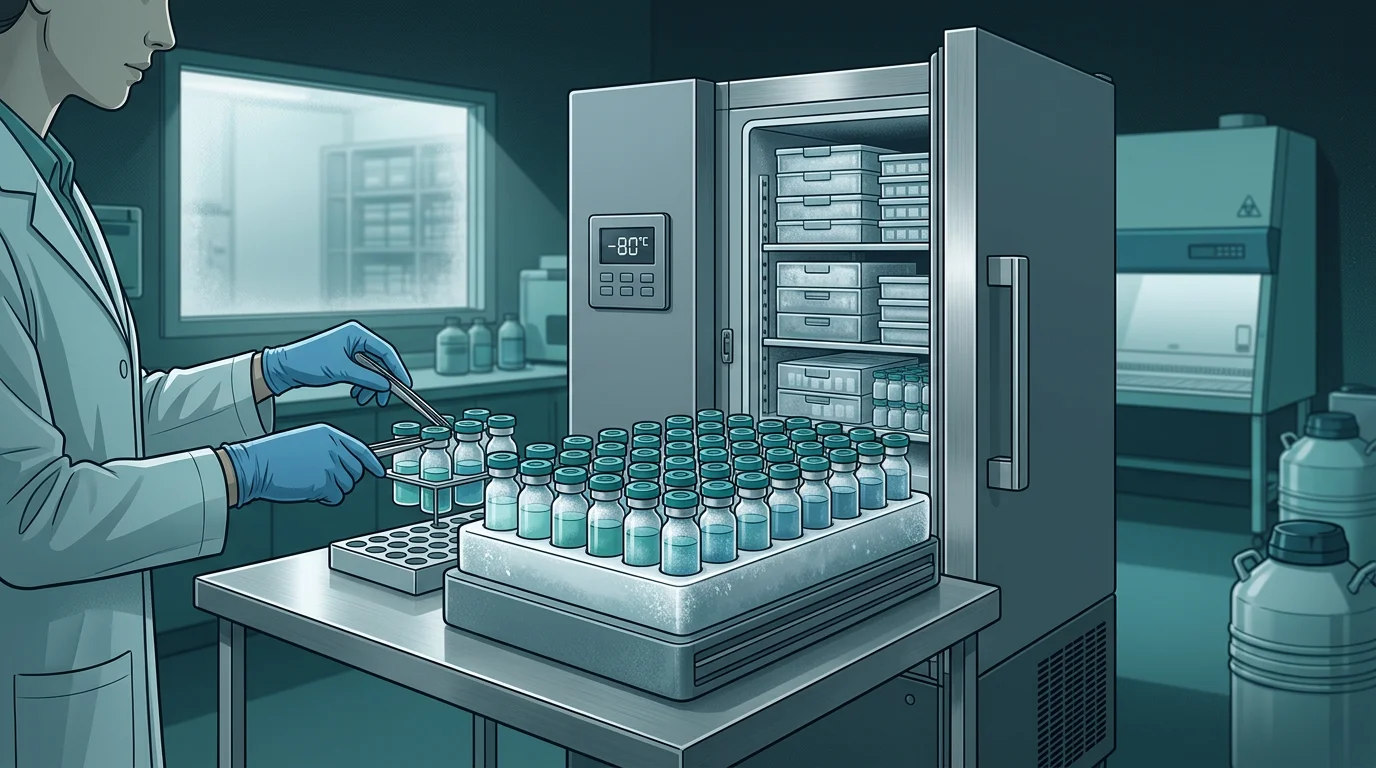
- Store at -20°C to -80°C for long-term (months to years)
- Store at 2-8°C for short-term (weeks to months)
- Keep desiccated (with desiccant packs)
- Protect from light
- Avoid repeated freeze-thaw cycles
Reconstituted:
- Store at 2-8°C (refrigerated) always
- Use within 30-60 days
- Never freeze reconstituted peptides
- Protect from light (use amber vials or wrap)
- Keep sterile (don't contaminate)
Signs of Degradation
Watch for these warning signs:
| Sign | Possible Cause |
|---|---|
| Yellow/brown discoloration | Heat or light exposure |
| Clumping or caking | Moisture exposure |
| Failed to dissolve | Severe degradation |
| Cloudy solution | Precipitation or contamination |
| Unusual odor | Bacterial contamination |
| Reduced effects | Loss of potency |
Do Not Use: If signs of degradation are observed, do not use the peptide. Contact the vendor immediately with documentation (photos, lot numbers). Reputable vendors will replace or refund degraded products.
Community Resources and Due Diligence
While this guide focuses on objective quality indicators, community experience can provide additional context.
Using Community Forums Wisely
Valuable community input:
- Long-term user experiences with specific vendors
- Batch-to-batch consistency reports
- Customer service experiences
- Shipping and packaging quality
- Resolution of quality issues
Be skeptical of:
- Single anonymous reviews
- Only perfect or only terrible reviews
- Reviews lacking specific details (lot numbers, dates, testing)
- Vendor testimonials on vendor sites
- Compensation-based reviews
Third-Party Testing Databases
Some community resources aggregate third-party testing results:
Finnrick Analytics Database:
- Community-submitted testing results
- Tracks vendor performance over time
- Shows batch-to-batch variation
- Identifies problematic vendors
How to use these resources:
- Look for multiple test results (not single data points)
- Check dates (recent data more relevant)
- Note batch numbers (compare to what is being purchased)
- Consider trends (improving or declining quality)
- Use as one factor, not sole decision criterion
Conducting Independent Research
Before ordering:
- Search vendor name + "review" + "testing"
- Check established research forums
- Look for third-party test results
- Verify business registration if possible
- Contact the vendor with technical questions
- Request sample CoAs before purchasing
Questions to ask vendors:
- "Can a CoA be provided for the current batch?"
- "Which testing lab is used?"
- "What is the return policy for quality issues?"
- "How are temperature-sensitive peptides shipped?"
- "How long has this batch been in stock?"
Building a Vendor Evaluation System
Create a systematic approach to vendor assessment:
Initial Screening Checklist
Before ordering from any new vendor, verify:
- Batch-specific CoAs available
- Third-party testing conducted
- Physical address listed
- Multiple contact methods
- No medical/human use claims
- Reasonable pricing (not suspiciously cheap)
- Professional website and communications
- Clear terms and policies
- Adequate storage/shipping practices
- Positive community reputation
First Order Protocol
For an initial order with a new vendor:
- Start small - Order one vial or smallest quantity
- Request batch CoA - Before or immediately after ordering
- Verify CoA - Contact testing lab to confirm
- Document everything - Photos, lot numbers, dates
- Physical inspection - Check packaging and appearance
- Consider third-party testing - For expensive or critical peptides
- Monitor over time - Track storage stability
Ongoing Quality Monitoring
Even with established vendors:
- Periodically request updated CoAs
- Monitor for changes in quality or service
- Watch for community reports of issues
- Consider random third-party testing
- Track research outcomes
- Document any quality concerns
Practical Vendor Comparison Framework
Use this framework to compare vendors objectively:
Scoring System Example
Rate each vendor on these factors (1-5 scale):
| Factor | Weight | Vendor A | Vendor B |
|---|---|---|---|
| CoA Quality | 5x | ___ × 5 | ___ × 5 |
| Third-party testing | 5x | ___ × 5 | ___ × 5 |
| Shipping/handling | 3x | ___ × 3 | ___ × 3 |
| Customer service | 2x | ___ × 2 | ___ × 2 |
| Pricing | 2x | ___ × 2 | ___ × 2 |
| Community reputation | 3x | ___ × 3 | ___ × 3 |
| Website professionalism | 1x | ___ × 1 | ___ × 1 |
| Total Score | ____ | ____ |
Interpretation:
- 80-100: Excellent vendor, high confidence
- 60-79: Good vendor, acceptable
- 40-59: Marginal, proceed with caution
- Below 40: Avoid
Decision Matrix
| Scenario | Recommended Action |
|---|---|
| High-cost peptide, new vendor | Third-party test before use |
| Low-cost peptide, established vendor | Use with standard verification |
| Critical research, any vendor | Always third-party test |
| Multiple red flags | Avoid vendor entirely |
| One red flag, many green flags | Proceed cautiously with extra verification |
When to Walk Away
Some situations warrant finding a different vendor:
Absolute deal-breakers:
- Refuses to provide CoA after purchase
- Cannot verify CoA authenticity
- CoA clearly fabricated
- Product fails third-party testing significantly
- Vendor becomes unresponsive after payment
- Multiple community reports of serious issues
- Makes illegal health claims
- Violates regulations openly
Consider alternatives when:
- Inconsistent quality batch-to-batch
- Poor customer service
- Shipping problems persist
- Prices increase dramatically
- Website or business model changes suddenly
- Better-rated vendors available for same peptide
Remember: Switching vendors has a cost (new evaluation, testing), but continuing with a problematic vendor has a higher cost (invalid research, wasted resources, potential safety issues).
Conclusion
Evaluating peptide vendors requires diligence, but the investment protects research integrity and resources. Key principles:
- Demand documentation - Batch-specific CoAs are non-negotiable
- Verify independently - Don't trust marketing, verify claims
- Understand testing - Know what HPLC and MS results mean
- Watch for red flags - Many indicate deeper problems
- Value green flags - Quality vendors demonstrate competence
- Monitor continuously - Quality can change over time
- Test when it matters - Third-party testing provides certainty
- Trust good judgment - If something seems off, it probably is
The bottom line: Reliable peptide sources invest in quality testing, transparent documentation, and proper handling. These costs are reflected in pricing, but the value is invaluable for research integrity.
Cost Perspective: A $100 peptide from a questionable vendor that invalidates research is far more expensive than a $150 peptide from a verified vendor that produces valid results.